קורס AI Security להסמכת TAISE של CSA
קורס AI Security להסמכת TAISE של CSA // קורס AI Security להסמכת TAISE של CSA //
+ADVANCED
רמה/שלב
3 או 4 ימים בוקר (2 אופציות)
משך זמן
24/32
שעות אקדמיות
בוקר פרונטלי, 22,21,20 בדצמבר (מעבדות: 23/12)
מועד פתיחת קורס
9 עד 16
ימי ושעות לימוד
- מידע על הקורס
- תעודות
- מחזור לפניי
- קורסים נוספים
מועדי המחזורים הקרובים
חלופה א' - לימודי בוקר:
שלשה ימים עיוניים פרונטליים: 22,21,20 בדצמבר, [09:00 עד 16:00]
ואופציה לתוספת יום מעבדות: 23 בדצמבר 2026 [09:00 עד 16:00]
קרא עודמטרת הקורס
הצלחה גדולה - מחזור 6 בתוך 3 חודשים
קורס ההסמכה Trusted AI Safety Expert (TAISE) נועד להעניק למומחי ענן, סייבר, בינה מלאכותית ורגולציה הבנה וכלים ליישום אבטחה, אחריות וממשל לאורך מחזור החיים המלא של מערכות AI.
ההכשרה נועדה לאפשר למשתתפים להוביל פרויקטים ויוזמות בתחום הבינה המלאכותית הארגונית – החל מהבנה של מודלים גנרטיביים וארכיטקטורות מתקדמות, דרך ניהול סיכונים וציות לרגולציות (כגון AI Act וה-NIST AI RMF), ועד ליישום בקרה, פרטיות, שקיפות ואבטחת ענן במערכות AI בעלות השפעה תפעולית ועסקית.
הקורס מקנה ראייה הוליסטית: שילוב בין ממדים טכנולוגיים, אתיים ורגולטוריים – ומכין את הלומדים לקבלת ההסמכה הרשמית של CSA בשיתוף Northeastern University, שתאפשר להם להוות סמכות מקצועית בארגונם בתחום AI Safety and Trust ולתמוך בהטמעה אחראית ובטוחה של AI בקנה מידה ארגוני.
האופציה ליום הרביעי: מעבדות תרגול מעשי.
קרא עודלמי התעודה מתאימה
למומחי ענן, למומחי סייבר, למומחי AI, לעוסקים ברגולציה ולמקצוענים האחראים לפיתוח, הטמעה וניהול מאובטחים של מערכות AI. למשל:
· הובלת אימוץ בינה מלאכותית: קידום אסטרטגיות AI בארגון, גישור על פערי ידע בין צוותים, ויישור היוזמות העסקיות, האתיות והרגולטוריות.
· בניית מסגרות ממשל (Governance): פיתוח ואכיפה של סטנדרטים לשימוש אתי ב-AI, ניהול רגולציות מרובות תחומים ותיעוד להפחתת סיכון משפטי ומוניטיני.
· הגנה על פרטיות: יישום עקרונות של Minimization, אנונימיזציה ו-Governance לאורך מחזור חיי AI כדי להתאים ל-GDPR, CCPA וסטנדרטים גלובליים אחרים.
· ניהול סיכונים בינה מלאכותית: זיהוי והפחתה של איומים ספציפיים ל-AI, יישום מסגרות כמו NIST AI RMF ו-MITRE ATLAS, והקמת ניטור מתמשך.
· יישום אבטחה טכנית: אבטחת MLOps pipelines, יישום עקרונות Zero Trust, וחיזוק תגובת Incident Response בסביבות AI ו-Cloud.
אם תחומי האחריות שלך כוללים אימוץ AI, ממשל, רגולציה, סיכון או אבטחה טכנית — התעודה מספקת לך את המסגרות, המיומנויות וההכרה להוביל.
קרא עודמדוע תעודה זו בולטת?
· מנהיגות מוכחת — CSA היא תקן גלובלי שמוכר על-ידי ממשלות, וארגונים עם למעלה מ־16 שנים בהובלת מגמה מקצועית בתחום אבטחת הענן.
· מצוינות אקדמית — פותחה בשיתוף עם Northeastern University, ומשלבת מחקר מתקדם עם למידה שממוקדת בתעשייה.
· מיומנויות מבוקשות — פיתוח מומחיות פרקטית לאורך מחזור חיי הבינה המלאכותית, כולל עבודה עם מסגרות כמו AICM של CSA, NIST AI RMF, ISO, MITRE ATLAS ועוד.
· הכרה והסמכה — קיבלתם Badge דיגיטלי ותעודה משותפת של CSA ו-Northeastern שניתן להציג בלינקדאין, בקורות חיים ובפרופיל המקצועי.
קרא עוד
מה כוללת ההכשרה וההכנה לתעודה
- חבילת קורס בן 10 מודולים של CSA + מבחן.
- מדריכי לימוד מקיפים.
- אסימון (token) למבחן עם 2 ניסיונות (תוקף לשנתיים).
- ספריית Prompt ל-AI.
- Badge דיגיטלי ותעודה עם מעבר המבחן.
- המחיר ל-3 ימים עיוניים: 4,407 שח לפני מע"מ, 5,200 שח כולל מע"מ.
- המחיר ל-4 ימים כולל מעבדה: 5,431 שח לפני מע"מ, 6,408 שח כולל מע"מ.
אודות משה פרבר
משה פרבר, מרצה, מפתח קורסים, ומנחה פודקאסטים, מכהן כיו״ר של הצ’אפטר הישראלי של Cloud Security Alliance (CSA Israel), יזם, יועץ וממובילי תחום הסייבר ואבטחת מידע, ובעיקר בתחום הענן.
מרצה אבטחת ענן בתכנית CISO במכללתSee Security למעלה מ-20 שנים.
החזיק בתפקידי ניהול בכירים בארגונים מובילים, והיה מעורב בהקמה של סטארט-אפים בתחום הסייבר.
קרא עוד
תוכן הקורס
TAISE Curriculum
Module 1: Introduction to AI
● Module 1 Overview
● Module Vocabulary
● Definitions and Concepts of Artificial Intelligence
● How is Machine Learning Related to AI?
● What is “AI”?
● History of AI Development
● Traditional and Generative AI
● Overview of Generative AI Modalities
● Cloud Service Models
Module 2: Generative AI Architecture and Design
● Module 2 Overview
● Module Vocabulary
● Mathematical Foundations for Machine Learning
● Understanding AI Architecture Paradigms
● The Transformer Architecture
● Attention Mechanisms Deep Dive
● Pre-training Architecture and Objectives
● How Generative AI Models Learn
● Architecture of Diffusion Models (Optional)
● Diffusion Models and Denoising (Optional)
● Data Ingestion and Storage Strategies
● Retrieval-Augmented Generation (RAG) Deep Dive
● Knowledge-Augmented Generation (KAG)
● Cloud Service Models for Generative AI
● Deployment Strategies and Hybrid Environments
● Security and Interoperability
Module 3: AI Use Cases: GenAI, Multimodal, and AI Agents
● Module 3 Overview
● Module Vocabulary
● Everyday Applications of Generative AI
● Image Generation Example: Deepfakes
● Risks and Challenges of AI
● Bias in Data and Algorithms
● Examples in Industry
● The Responsible AI Life Cycle
● Case Study #1—Personalized Medicine Through Multimodal AI
● Case Study #2—AI Chatbots in Mental Health
● Case Study #3—Charlotte AI: Cybersecurity’s First Generative AI Analyst
Module 4: Fairness, Accountability, and Explainability in AI
● Module 4 Overview
● Module Vocabulary
● Ethics in the AI Model Development Life Cycle
● Responsible AI in the AI Development Cycle
● Model Understanding
● Interpretability and Explainability Techniques
● Algorithmic Fairness
● Transparency Through Model and Data Documentation
● Communicating with Stakeholders
Module 5: AI Model Lifecycle and Threat Taxonomy
● Module 5 Overview
● Module Vocabulary
● Phases of AI Model Development
● Case Study: AI Model Development Life Cycle
● Understanding Threats
● Introduction to Threat Modeling
● Periodic Risk Reviews and Scenario-Based Risk Analysis
● Risk for AI Models
● Risk Management Using NIST AI RMF
● ISO/IEC Standards for AI Risk Management
● MITRE ATLAS: Adversarial Threat Landscape for AI Systems
Module 6: Model Governance, Risk Management, and Compliance
● Module 6 Overview
● Module Vocabulary
● Foundations and Current Regulatory Landscape
● Current US Regulatory Landscape
● European Union AI Act—Global Impact and Requirements
● AI Risk Management Frameworks and Standards
● STAR for AI, CCM, and AICM
● Framework Selection and Integration Strategy
● Organizational Structures and Accountability
● RACI Models for AI Systems
● AI Governance Committees and Decision-Making
● Accountability Frameworks and Escalation Procedures
● Documentation, Compliance, and Implementation
● AI Policy Development and Implementation
● Audit Trails and Continuous Monitoring
● Cross-Border Challenges in Global AI Development
● Implementation Roadmap for Organizations
Module 7: Introduction to AI Safety and Security
● Module 7 Overview
● Module Vocabulary
● An Analytical Framework for Safety and Security
● Distinguishing AI Safety and Security
● Key Security Challenges in AI Systems
● AI-Augmented Cybersecurity Testing and Red Teaming
● AI Tools for Zero Trust Implementation
● Challenges in Securing Generative and Agentic AI Systems
● Case Study #1: LLMs for Automated Phishing Scams
● Case Study #2: Secure Data Flow in Multinational Operations
Module 8: Cloud and AI Security
● Module 8 Overview
● Module Vocabulary
● Introduction to Cloud Security for AI Systems
● Secure Deployment and Management of AI Models on Cloud Platforms
● Continuous Monitoring and MLOps Pipeline Security
● Incident Response and Disaster Recovery for AI in the Cloud
● Zero Trust Architecture for AI Workloads and Cloud Deployments
Module 9: Data Security & Privacy in AI Systems
● Module 9 Overview
● Module Vocabulary
● Privacy and Security for Machine Learning
● Data Authenticity, Anonymization, and Minimization Techniques
● Data Quality Management and Preprocessing Strategies
● Data Lineage and Metadata Management
● Leveraging Synthetic Data
Module 10: Continuous Learning and Adaptation
● Module 10 Overview
● Module Vocabulary
● The Evolution Beyond Static Models
● Setting Up Monitoring and Data Drift Detection
● Online Learning and Model Update Strategies
● MLOps Integration and LLMOps
● Incorporating User Feedback and Incident Integration
● Educating Stakeholders on AI Risks and Limitations
● Operationalizing Continuous Learning
TAISE Labs (4th day)
TAISE Hands-On Labs: Securing AI on Cloud Platforms
Students receive a dedicated cloud account with a pre-deployed AI chatbot that is intentionally vulnerable. Across five labs, students secure it layer by layer — no coding required.
Platform: AWS Amazon Bedrock (Azure AI & Google Vertex AI tracks to follow)
Lab 1: Secure Network Architecture for AI Services
• Zero Trust network design for AI workloads
• VPC Endpoints (PrivateLink) and private connectivity to AI services
• Security Group micro-segmentation and cross-referencing
• Endpoint policies and least-privilege network access
• Private DNS resolution for AI service endpoints
Lab 2: IAM Permissions & Authorization for AI
• Auditing overly permissive IAM roles and policies
• Principle of least privilege for AI service access
• Infrastructure-level vs. application-level authorization
• Scoping permissions to specific models and actions
• Layered policy evaluation (IAM + endpoint policies)
Lab 3: AI Guardrails & Content Safety
• Content filtering for toxic and harmful inputs/outputs
• PII detection and redaction in AI interactions
• Denied topic configuration for organizational policy enforcement
• Prompt injection and jailbreak defense
• AI safety vs. AI security considerations
Lab 4: Secure Data Access & RAG Integration
• Retrieval-Augmented Generation (RAG) architecture and security
• Knowledge base connectivity and vector database protection
• Cross-account trust boundaries and data plane isolation
• Data lineage and access control for AI data sources
• Grounded responses vs. hallucination reduction
Lab 5: Security Monitoring & Audit Trails for AI
• Model invocation logging for AI interactions
• Security event detection and automated alerting
• Monitoring dashboards for AI workload visibility
• Guardrail trigger analysis and compliance reporting
• Incident response integration for AI systems
קרא עוד
תעודות
DIPLOMA
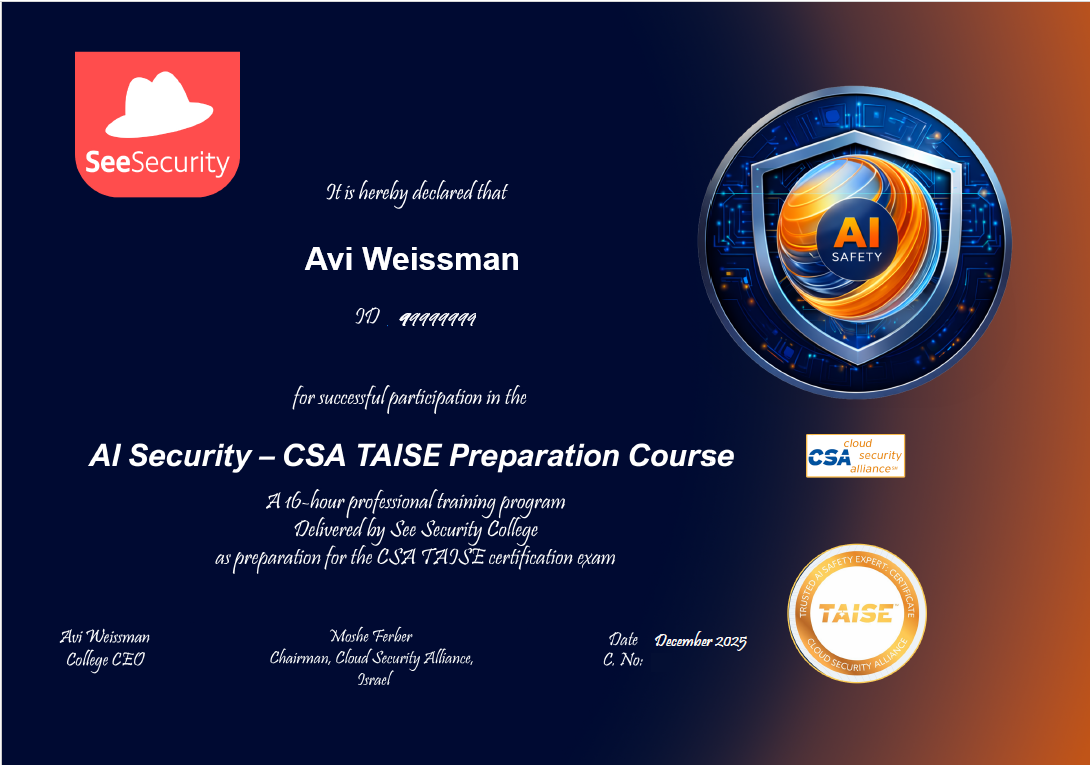
12-2025
MORE COURSES
קורסים נוספים שיכולים לעניין אותך

קורס CISO המקורי שנכתב עבור מערכת הבטחון, משלב את CISO, את DPO ומכין למבחן CISSP.
תכנית לימודים אמיתית, עם דרישות סף ומדדי מעבר. כמו תמיד, בשיא סקיוריטי מתעקשים ליצור מנהיגים, לא מקבלים את כל מי שמשלם, לא "מחלקים תעודות בלי עבודות ומבחנים", ונלחמים ב"קונספציה".
הצטרף למועדון הבוגרים האדיר והגאה בישראל של תוכנית הלימודים היוקרתית. התוכנית היחידה בעולם שהוכרה על ידי 2(ISC) תוכננה בשיתופם, ואומצה באופן בלעדי על ידי צה"ל ומערכת הביטחון. נועדה להכשיר ארכיטקטים בתחום הטכנולוגי-טקטי, ומתודולוגים בתחום המנהלי-ממשלי.
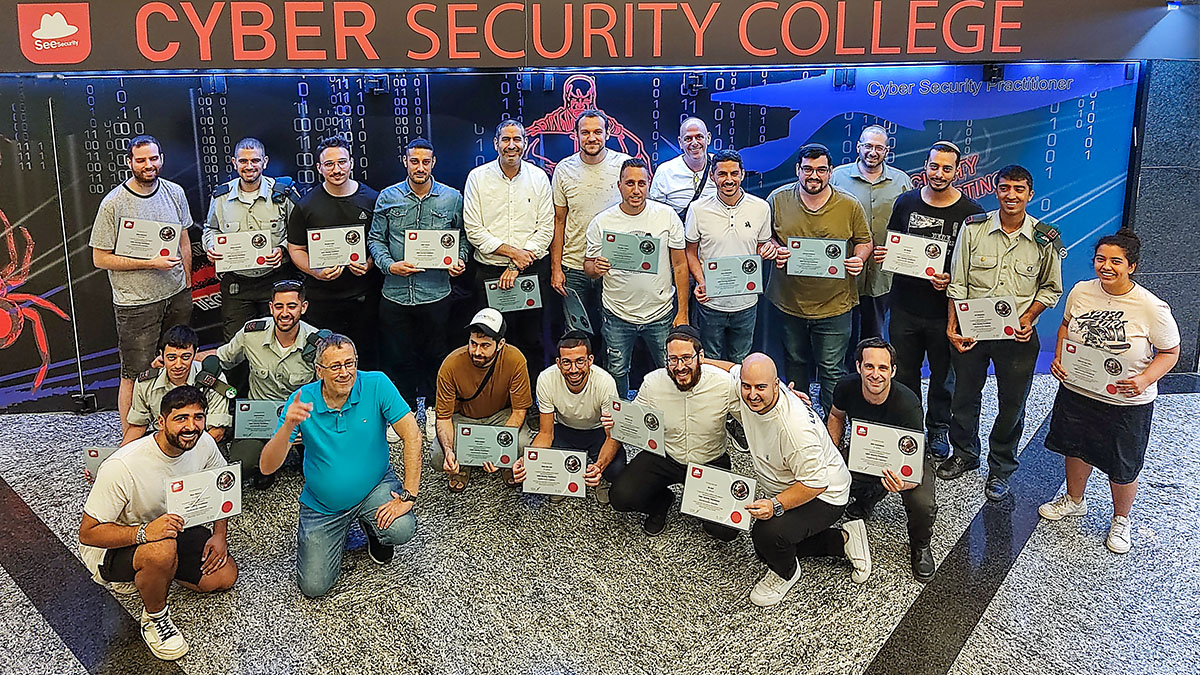
קרא עוד

קורס CISO של שיא סקיוריטי הוא תוכנית יוקרתית ומוקפדת להכשרת מנהלי אבטחת מידע – לא אוסף הרצאות שנועד להעניק תעודה. התוכנית משלבת את המרצים הבכירים בישראל, למידה אונליין עם בסיס חיוני פרונטלי מועט ושילוב AI. לצד הידע המקצועי, תצטרפו לקהילת ה־CISO הגדולה בישראל, תבנו נטוורקינג איכותי ותרכשו את היכולות הנדרשות להוביל את אבטחת המידע בארגון.
קרא עוד
קורס ארכיטקט הגנת סייבר מכשיר מומחי טכנולוגיות האמונים על בחירת הכלים, הטכניקה והשילוב שלהם, לשם בניית מערך ההגנה הטכני המיטבי.
תכנית הלימודים היוקרתית CSTP נועדה להכשיר מומחי הגנת סייבר המסוגלים לייעץ, להנחות ולקבל החלטות במשימות הגנת המידע, בתחום הטכנולוגי-טקטי (ללא התחום המינהלי-מימשלי). התוכנית תקנה לסטודנטים היכרות מעמיקה עם אסטרטגיות, טקטיקות, טכניקות, והוראות העבודה הנהוגות (Best Practice) בתחומים אלו, לרבות הכרת תורת התקיפה והמודיעין.